
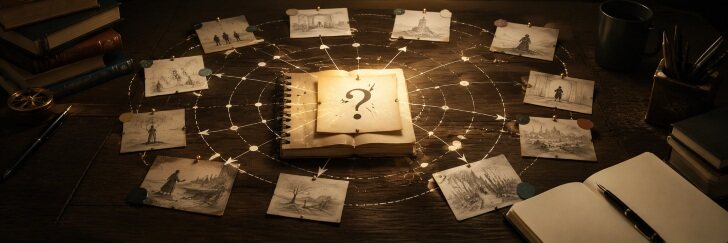
A plot is not a list of things that happen. It is a problem trying to change shape.
This is why many story ideas feel busy but weak.
A character moves to a new town. Gets a job. Meets someone attractive. Has an argument. Discovers a secret. Goes to a party. Makes a mistake.
Those are events.
Events can fill pages, but they do not automatically create story. A story begins when the writer understands the problem underneath the events.
The problem is the pressure that makes the plot matter.
A boy is not just moving to a new town. He is trying to become someone no one there knows how to hurt yet.
A man is not just starting a new job. He is trying to prove he is still useful after a failure he cannot forgive himself for.
Two friends are not just spending more time together. They are trying to preserve a safe friendship while the truth between them becomes harder to ignore.
Once you know the problem, the plot gets sharper.
Every scene can either complicate the problem, reveal the problem, pressure the character to avoid it, or force the character to face it. Without that center, scenes become errands. With it, even quiet moments can carry tension.
Before outlining chapters, finish this sentence:
“This is a story about someone who must deal with…”
Not what happens. What is wrong.
A fear.
A lie.
A need.
A wound.
A secret.
A contradiction.
A choice they have avoided.
The plot is how the problem moves.
If the problem is loneliness, the plot should not merely include social events. It should keep testing what the character will do to belong.
If the problem is shame, the plot should not merely reveal backstory. It should force the character into situations where hiding becomes more costly than honesty.
The useful question is not, “What happens next?”
Ask:
“What pressure would make this problem harder to avoid?”
That question turns incidents into structure.
Write the problem first.
Then let the plot become the path that forces the character through it.
The weak version starts by listing events:
He arrives in town.
He sees his old house.
He runs into an ex.
He gets a job.
He argues with his brother.
He discovers a family secret.
Those events may be useful, but they do not yet create a strong story. They are things that happen.
The stronger version starts with the problem:
He left because he believed disappearing was the only way to survive shame.
Now the plot has a center.
Returning home is not just a setting change. It pressures the problem because he has to face the people who remember him.
Seeing the old house is not just nostalgia. It pressures the problem because the place still holds the version of himself he tried to bury.
Running into his ex is not just romantic tension. It pressures the problem because this person knows the truth he has rewritten.
Arguing with his brother is not just family conflict. It pressures the problem because his brother refuses to let him pretend leaving hurt no one.
The same events become stronger because they are all working on the same wound.
The question is no longer, “What happens next?”
The question becomes, “What would make hiding from this problem harder?”
That is how plot gains direction.
First, write down five events you think might happen in the story.
For example:
The character moves to a new place.
The character meets someone important.
The character has an argument.
The character discovers a secret.
The character has to make a choice.
Now stop and write one sentence:
“My character’s real problem is…”
Do not write the plot. Write what is wrong underneath the plot.
Examples:
“My character’s real problem is that he believes being useful is the only way to be loved.”
“My character’s real problem is that he avoids honesty because honesty once cost him everything.”
“My character’s real problem is that he wants belonging but only knows how to perform for approval.”
Now return to your five events.
For each one, ask:
How does this event pressure the problem?
How does it make avoidance harder?
What does it reveal about the character’s wound, fear, lie, or need?
What would make this event more connected to the central problem?
Does this scene change the pressure, or is it only taking up space?
If an event does not pressure the problem, revise it or remove it.
A strong plot is not built by adding more things.
It is built by making the right things matter.
Acknowledgement: AI was used in the creation of this article and artwork.
-
 2
2
Recommended Comments
There are no comments to display.
Join the conversation
You are posting as a guest. If you have an account, sign in now to post with your account.
Note: Your post will require moderator approval before it will be visible.