
-
Newsletter
Sign UpKeep in touch with what's going on at Gay Authors and get emailed story recommendations weekly.
- Author
- 08/16/2025
- 4,651 Words
- 1,175 Views
- 10 Comments

Note: While authors are asked to place warnings on their stories for some moderated content, everyone has different thresholds, and it is your responsibility as a reader to avoid stories or stop reading if something bothers you.
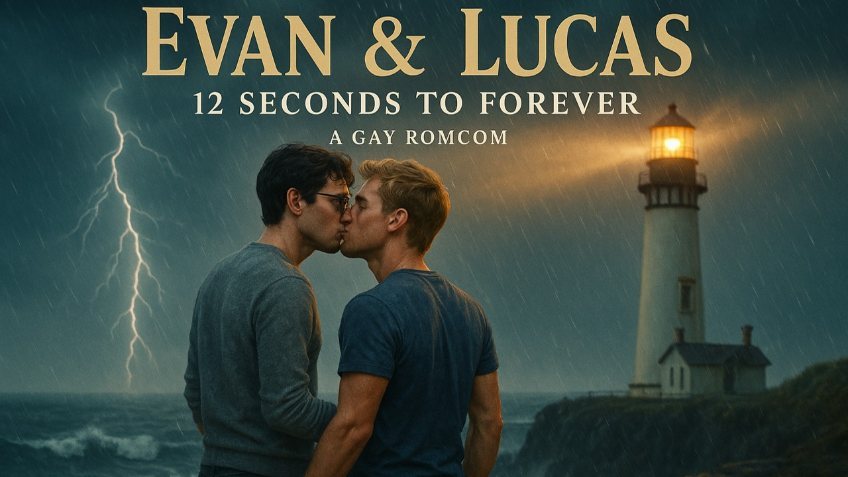
12 Seconds To Forever - 1. Chapter 1
I came for silence.
Silence, in my experience, is not the absence of sound. It’s the presence of one good sound repeated until it becomes a lullaby: the hush of a page turning, the kettle’s soft complaint, a wave arriving, leaving, arriving again. That’s what I wanted — no phones, no notifications, no well-meaning friends suggesting “a change of scenery will fix you right up.” Just a rented cottage on a wind-gnawed cliff and the lighthouse across the way, cutting a white blade through the dusk every twelve seconds.
Twelve seconds felt like a reasonable interval. In twelve seconds you can breathe. You can think. You can compose a sentence that is not about the person who left you six months ago with a note that said, in blue ink — fussy, careful letters, the kind you use when you want to look kinder than you’re being — I can’t be the quiet you require.
I did not come for a man in wet flip-flops.
“Delivery,” he said, on my first afternoon, and swung the cottage door open with a hip as if it belonged to him. The door, I mean. “Toothbrush. Uncle says you writers forget basic human needs once you start brooding.”
He was all salt and summer: tanned forearms spattered with white paint, a navy tee shirt that had lost the argument with his shoulders, and hair that couldn’t decide between curl and chaos. He held up a toothbrush like a flag. It was patterned with little anchors.
“I brought my own,” I said.
“Backup brush,” he said, unfazed. “Redundancy. Marine standard.” Then, without waiting to be invited, he padded across the old pine floor, dripping faintly, and set the toothbrush in a blue ceramic cup by the sink. “I’m Lucas.”
“Evan,” I said, as if that would make him go away.
“Welcome to Gull’s Head,” he said, turning in a slow, admiring circle that I refused to be flattered by. He meant the village, I think, but his eyes took in the cottage: the low beams, the stiff white curtains, the table I hoped would soon host triumphant paragraphs instead of my elbows. “If you need anything, and you will, because men rarely know how to pack, I’m at the lighthouse, and so is Uncle. You’ll hear the foghorn at night if the wind swings north. It sounds like a whale with opinions.”
He grinned at me. I did not grin back. But something in me had the nerve to wonder what it would be like to grin back.
He made no move to leave. He strolled to the window and put his palm on the glass as if the view required steadying. The lighthouse stood on its knuckle of rock beyond the cove: white stone, red lantern room, the fan of the gallery like a child’s sketch of a crown. The beam winked once, twice, and then vanished into daylight, as if embarrassed to have been caught.
“You get the light straight in at night,” he said. “Best sleep of your life. Some people complain, but I say, if you can’t sleep to a heartbeat like that, you’re listening wrong.”
“I like quiet,” I said.
“And yet,” he said, cheerfully, “you rented a cottage across from the loudest heartbeat in town. Interesting choice, Evan-who-likes-quiet.”
“It’s not loud,” I said. “It’s predictable.”
He pointed the toothbrush at me. “Ha. Spoken like a man in recovery. If you were a boat, what would you be?”
“I am not a boat,” I said.
“Correct,” he said, as if I’d passed some test. “Because you are ashore, and because you have shoes that were not designed for sand. But if you were a boat.”
I sighed, which seemed to please him. “A dinghy,” I said. “Small. Useful. Not flashy.”
He wrinkled his nose. “Or a lighthouse tender,” he said. “Reliable. Sturdy. Brings supplies when it counts.”
Before I could reply, he tapped the toothbrush at me in a salute and backed toward the door. “I’ll be by tomorrow,” he said. “With shampoo. You forgot shampoo.”
“I didn’t —”
But he was gone, swallowed by the sunlight, the door thumping shut with an old-house sigh. I stood in the middle of the cottage and seriously considered moving the table in front of the door to prevent further incursions. Then I considered the fact that I had written zero words in three months and an actual human had just brought me an object that suggested care. I put the toothbrush back in its cup and tried not to admit that I liked the anchors.
***
That first night, was a ribbon of silver pulling across the ceiling every twelve seconds. I lay in bed and matched my breath to it, in and out, in and out, and imagined the lantern room high and warm and wind-struck, a revolving heart. You can understand a lot about yourself if you’re willing to lie awake and be lit, fraction by fraction, by the same piece of sky.
In the morning, coffee tasted almost like writing. I opened my notebook and wrote a sentence. Then I crossed it out because all first sentences are liars.
On cue, as if summoned by narrative, Lucas arrived again. He did not knock. He did, however, have shampoo.
“Delivery,” he said, holding up a bottle of something with a sea-green label. “Sea kelp. It’s like salad for your hair.”
“I brought —”
“Also,” he said, spinning another bottle out from under his arm like a magician, “conditioner. If you say you don’t need conditioner, I will eat my flip-flop.”
“Please don’t,” I said. “I don’t need the visual.”
He put both bottles on the counter and glanced at my notebook, which I closed, which he pretended not to notice. “Hike later?” he said. “There’s a trail behind the lighthouse. Views that’ll make your metaphors behave.”
“I came to work,” I said.
“Work is good,” he said. “Work likes to be watched. Bring it to the porch. I’ll paint the railings and hum obnoxiously, and your sentences will stay in line out of spite.”
“It’s possible,” I said, “that you are the enemy of art.”
“It’s possible,” he said, “that art has been waiting for a heckler. Ten a.m. Don’t make me send the foghorn for you.”
He left, and I stared at the shampoo and had a small, ridiculous laugh. It had an anchor on it.
The third day he brought paper towels. The fourth day, a bar of soap that smelled like pine. The fifth, a corkscrew (“men always forget corkscrews”); the sixth, a bag of tea that he assured me was “for the brooding hours; it has bergamot, which sounds like a mid-century detective and therefore must be good.” By then, I had accepted that he was not going to knock, and that my life had acquired a secondary rhythm: the thump of the revolving light, and the cheerful clatter of Lucas arriving with yet another essential I had, in fact, already packed.
“Is there a reason you’re delivering these one at a time?” I asked, when he turned up with a wooden spoon.
He inspected the spoon as if it had just spoken. “Pacing,” he said. “You’re a writer. Pacing is everything.”
“Pacing is for stories,” I said. “Not for basic hygiene.”
“I disagree,” he said. “A man should never peak too soon. Today: spoon. Tomorrow: mystery.”
“Is the mystery… salt?” I said.
He gazed at me in awe. “Don’t spoil Act Two.”
When I told him I wasn’t great with heights, he nodded seriously and said, “Excellent. We’ll start with low cliffs and work up.” When I told him I was not there to talk, he said, “Excellent. You can listen, then,” and proceeded to lecture on the engineering of Fresnel lenses while balancing on one leg to scrub a paint smear off his calf. When I told him I did not swim, he said, “Excellent,” and showed up the next day with a pair of ridiculous inflatable armbands in the shape of seahorses. They were lime green. I put them on a shelf in the kitchen and told myself I would throw them away. I did not throw them away.
If this sounds like I was charmed against my will, I was. Charm is less a force than a weather pattern; you notice it after you’ve already been rained on. Sometimes it manifests as competence, sometimes as kindness, sometimes as a refusal to be discouraged by another person’s careful edges.
The weather, meanwhile, shifted in earnest.
By the end of the week the village braced itself with the efficient choreography of a place that remembers. Boards went up over windows. The grocer closed early. The harbor tucked its boats as if tucking children. Lucas arrived, hair darker with sea spray, and dropped a fat orange candle on my table.
“Storm,” he said. “Tonight, probably through tomorrow.”
“I saw the warnings,” I said. The air had that iron taste it gets before trouble, as if the sky chewed nails for breakfast.
“We’ll be at the lighthouse,” he said. “Stone beats timber. If you’ve got sense, you’ll come up. I have been known to loan out sense.”
“I have a cottage,” I said.
“You have a cottage with glass in it,” he said, and his voice did a new thing — lost a fraction of its lightness, gained a thread of insistence. “Please, Evan. You don’t have to like me to accept a better wall between you and the wind.”
His hand hovered over the back of a chair. I understood that something in his cheerful weather was, in fact, choreography too; that he was used to being ease itself because ease, given freely, is what makes people do the sensible thing. That he also, under it, had worry like a taut rope. I closed my notebook.
“I’ll pack a bag,” I said.
“Packing is for quitters,” he said, hurricane returning to his tone. “We have a list. Ready? Boots. Jacket. Flashlight. Your glasses, if you take them off to sleep. A sweater that can be forgiven if it dies. And your manuscript, if you have one.”
“I don’t,” I said, and felt a shame that tasted like salt.
He slung a duffel over his shoulder and looked at me squarely for the first time all week. The corners of his mouth softened. “Then bring your blank pages,” he said. “They need to learn what thunder sounds like.”
We climbed the path between tufts of grass the wind had already combed flat. The lighthouse grew larger and somehow younger as we approached, shedding its postcard nostalgia for a working person’s face. Stout. Ready. The first drops hit my cheeks like cool warning bells.
Inside was a spiral — of course it was: iron steps, central column, handrail worn by long hands. It smelled like oil and old chores. Lucas nodded to a tidy kitchen to the right of the door and an office to the left, then led me upward, the light narrowing, the air warming.
The lantern room felt like stepping into the throat of a lantern. Glass — thick, ribbed, cathedral-clear — caught the last pale daylight and made it ring. The lamp itself sat in its cradle like a docile beast; the lens caged it in delicate geometry, a hive built for brightness. The sea was a low, gray cat, purring until it didn’t.
“You can see the whole village from up here,” Lucas said, which was mostly true if you liked your villages as cartoons of roofs. “And the weather, early.”
He moved around the lantern room with unshowy competence, checking gauges, peering at the generator panel, thumbing a paperback manual whose pages were soft and familiar. “Uncle’s resting,” he said, as if I’d asked. “He twisted his knee last week lifting a crate he swore weighed ‘exactly two sandwiches,’ so I’ve got this while the storm’s on.”
“You’re — what do you call this? An assistant keeper?” I said.
“Apprentice meddler,” he said. “Seasonal nephew. I study marine engineering when I’m not playing fetch with the ocean.”
Wind slapped the windows in a way that was not, strictly speaking, a metaphor. The beam came on as if it had decided we’d had enough of suspense. It swept, slow and righteous, across the gray — across my face, too, and Lucas’s, and the room.
“See?” he said. “Heartbeat.”
The first thunder rolled in from nowhere and everywhere. The second was closer. The third put a decision in my body I did not know I’d made: stay.
We set up camp two floors down where the stone walls were thickest. The kitchen delivered a stew that could have fought off any number of existential crises. Lucas talked. I learned more about light than I knew there was to learn. Fresnel lens, he said, pronouncing it with smug French competence. Refractive index. Catadioptric. I nodded as if I weren’t enjoying it.
“Want to help with checks?” he said, later, rapping his knuckles on a panel that pretended to be asleep.
“You mean climb up into the glass throat during a storm,” I said.
“Yes,” he said, brightly. “You’ll be strapped in. Fair warning, I will talk the entire time. It’s how I hold the building up.”
“Fine,” I said. “But if you tell me about your favorite sandwich fillings again while lightning looks for a hobby, I will throw you to the favorite lightning.”
He gave me a harness and a briefing and a smile that managed to be professional and delighted at once. We climbed. The wind shoved. The light swung its wide arm through rain and then through us, like anointing.
We were halfway through the checklist when the room hiccuped.
That is what it felt like: a hiccup in the mechanism, a catch in the light’s throat that made the beam twitch. Lucas swore in a way that suggested respect for words. He lunged for a lever, steadied something, frowned at the gauge as one frowns at a dog about to make a bad choice.
“Stay,” he told the lighthouse, absurdly. It did not. The beam stuttered again, more pronounced. He opened a housing and a hiss of rain-stiff air and old heat hit my face. “Generator’s being coy,” he said. “The backup’s sulking. Hold this?”
He slid a metal bar into my hands, then my palms, because the bar was less a bar and more a muscle of the machine, and the machine was suddenly a thing that needed muscles and hands. My fingers found the notches where someone else’s fingers had found them.
“I’m not mechanical,” I said.
“You’re human,” he said, already elbow-deep. “That’s better.”
It is an odd thing to be necessary. I felt my breath go low, my eyes go quiet. The room shrank to Lucas’s shoulders and the small white scar that lived near the base of his thumb and the way the rain made a thousand silver needles on the glass. He worked with a speed that was not panic—more like a dance he’d learned: loosen here, tighten there, coax rather than force, curse when appropriate. The beam went dark for a beat, and darkness in a storm feels like a dare.
“Come on,” he said to the generator, as if to a stubborn friend. “You and me. Uncle’s knee. Show me your good behavior.”
The generator considered, coughed, and then, with a grumpy flourish, returned to itself. The beam came back with a sweep that felt like a laugh.
Lucas grinned—a brief, fierce thing that I found myself wanting to keep. “Knew you had it,” he said. “You okay?”
“I’m holding a lighthouse,” I said.
“You’re good at it,” he said, and turned his grin on me.
He went to close the housing and, because storms love irony, the wind pitched a handful of rain into his face and drove the door against his hand. He jerked it back, swore, and in that word was pain like a dropped wrench.
“Let me see,” I said, too fast.
“It’s fine,” he said, too fast.
“Lucas.”
He held it out. A crescent had opened across his palm, tidy as if drawn by a stern teacher. Blood — no metaphor there — welled obediently. The sight of his skin unbuttoned did a strange, tight thing in my chest; not fear — anger, maybe, at the world for scuffing him.
“Downstairs,” I said. “Water. Bandages.”
“Bossy,” he said, faintly pleased. “I like it.”
We clanged down two floors, wind humming in the iron. In the kitchen, the light’s rhythm pressed through the walls—twelve seconds, twelve seconds. I washed his hand with the care of a man who once learned to do tenderness and, for a while, forgot. He watched me with a silence I had not, until then, seen him wear. It suited him.
“You talk when you’re scared,” I said, after a while.
He exhaled through his nose, which was as good as a nod.
“And when you’re not,” I added.
“I am a generous person,” he said.
I taped the bandage. He flexed his fingers and winced and made that face people make when they’re deciding whether to be brave. “Confession time?” he said.
“Do I get a choice?”
“No,” he said, and the storm boomed agreeably in the rafters like a laugh track. “Uncle gave me a box for you. On day one. Shampoo, soap, paper towels, tea, candle, corkscrew, wooden spoon, salt — the whole prop cupboard. He told me to bring it right up.”
“And you ignored him because you hate efficiency,” I said.
“And because I wanted excuses,” he said, and the look he gave me then did not ask for a joke. “I wanted reasons to come over that were not ‘hey, I like your face and the way you stare at the sea like you’re trying to edit it.’ I wanted… time. To see if you’d let me.”
I realized, abruptly, why the light had felt like a heartbeat: because every time it painted Lucas’s cheekbones, something in me moved. “You could have just—” I began, and stopped, because the sentence was not honest. I would not, in week one, have invited this into my quiet.
“You like predictable things,” he said, gentle. “I thought I’d come with a schedule.”
“Twelve seconds,” I said.
He laughed, and lightning reached its hands into the windows and rattled them for emphasis. The generator grumbled like an old dog but held.
“Stay up here,” he said, when the worst of the laughter passed. “We’ll ride it out in the lantern room. We need to keep an eye on the beam. And the gallery’s safer than the stairs if something shifts. Also, if the roof goes, we get to say we saw the sky fall.”
“This is your idea of reassurance,” I said, but the truth put its hand on my shoulder: I wanted to go back up. I wanted the glass, the light, the sense that we were inside a lantern and the world was the moth.
We climbed again, slower. The room received us like a church receives a storm: unimpressed, ready. Lucas strapped us both, belts and brass, to a ring in the floor. The beam made its lazy revolution, except lazy is the wrong word; it was deliberate, like a metronome that knows music will fail without it. Rain wrote to us on the panes. Wind signed its name under the letters.
We were four hours in the lantern room and then six. Time stops meaning anything during a storm except the space between one sensible choice and the next. We checked what there was to check, and when there was nothing, we sat with our backs to the lamp’s pedestal and let the light pass through our faces.
He told me about school: the way he loved the math of water, the way problems yielded if you stopped trying to impress them. He told me how he’d come for the summer when his uncle’s knee went stubborn, and how it felt good to be needed by something as uncomplicated as a tower that says here. I told him about the time I wrote a novel that made my mother cry in the wrong way, and the time a reviewer called my prose “measured,” which sounded like a compliment until someone else called it “quiet to the point of anesthesia.” I told him about the fluorescent-lit room where the man I loved said I need noise and left.
“Quiet is not absence,” I said, surprising myself. “It’s… attention. It’s hearing one thing properly.”
“I am very bad at that,” he said, with mock solemnity.
“You are very good at pretending you’re bad at it,” I said.
He tilted his head, considering me the way you consider a knot. “I talk,” he said, slowly, “because it feels like a rope. If I stop, I’m not sure what I’m tied to.”
“Me,” I said, and then tried to take it back with a mouth I no longer fully controlled. “Sorry. That sounded...”
“It sounded right,” he said.
The light touched his mouth and moved on. The storm battered its hands tired against the glass and then, grudgingly, took a breath.
We did not so much decide to kiss as realize we had moved into a sentence where that, grammatically, was the next word. He leaned in, unshowy. I did not retreat. The strap dug into my shoulder. The room smelled like hot metal and rain and the memory of soap. His mouth was warmer than the world. It did not fix anything. It did not have to.
Twelve seconds. Twelve seconds. The beam turned. Between flashes, we were shadow. Then we were lit again, two men with wind in their hair and a difficult benevolence in their lungs, suspended like pages in a book that had finally found its verb.
Morning arrived as if it had been waiting in a room down the hall for the storm to finish rehearsing. The sky opened its blue like a clean sheet. The village uncurled. The sea put its claws away and pretended innocence. Down on the path, gulls performed whatever ceremony gulls perform in the aftermath of drama, which involves a lot of screaming and no decorum.
We unstrapped. We climbed down. The kitchen made toast taste like victory. Lucas flexed his bandaged hand and made the face of a person who intends to pretend it doesn’t hurt.
“You should get that seen,” I said.
“It has been seen,” he said. “By a very stern person with excellent bedside manner and a vendetta against germs.”
“Mm,” I said, pretending not to flush. We stepped outside into a world that had been washed and wrung. The lighthouse gleamed as if proud of itself. The beam was off for daylight, and I missed it immediately.
He walked me down to the cottage, which had held its shape. The anchor toothbrush was still in its cup, smug with survival. The lime-green seahorses stared with existential surprise from the shelf.
On the table lay my notebook. The page was still blank. Except — it wasn’t. Some storm was still moving inside me, and where it went it left letters. I picked up my pen. Lucas leaned in the doorway like a man who intended to be a doorway for a long time.
“Coffee later?” he said, easy, unassuming. “I’ll bring —”
“Everything,” I said.
He smiled like a man discovering a new favorite word. “Everything,” he agreed. “I’ll leave the light on.”
***
I wrote. There are people who talk about inspiration as a lightning strike; I think it’s more like a lighthouse: steady, slow, unshowy, arriving again and again at the same place until you say fine, and open the door. He came every day with “deliveries” he no longer pretended were necessary: a pie his uncle swore cured survivor’s guilt, a coil of rope he’d found washed up like a paragraph in need of an editor, a postcard with a cartoon whale saying U OK?. He came with stories, and patience, and interruptions that didn’t feel like theft.
We hiked the low cliffs and the high ones. I wrote on the porch while he painted railings the color of restraint. He hummed. The sentences stayed in line out of spite and then, gradually, because they liked the company. We went to the market where the grocer called me “writer” as if it were my last name and slipped an extra lemon into my bag. We learned the weather of each other’s faces, the way delight moved, the way worry hid, the way a man looks when he’s deciding to be brave about small things. We discussed favorite sandwiches with an attention that bordered on theological.
When it was time to go—because the cottage was rented to someone else and a life, an actual life, waited inland—I put my anchor toothbrush in my bag and ignored the feeling that I was leaving a part of myself in the blue cup. He met me at the path with a box.
“For your city,” he said. “A very delayed delivery.”
Inside: a jumble that would make no sense to anyone but me. The wooden spoon. The tea. The candle. The ridiculous armbands with their green seahorses. A bar of soap. A corkscrew. The toothbrush I already held. Salt. A small sketch, done in pencil, of a lamp in a glass throat and a man’s hand on a metal bar, not holding up the lighthouse exactly, but participating.
“You’re a meddler,” I said.
“I am a lighthouse tender,” he said, softly. “It’s in the job description.”
I kissed him on the path. We didn’t discuss what came next; some stories deserve a present tense.
***
Back in the city, the noise pressed in on me like a badly tailored suit. I wrote, yes, but the sentences leaned toward the sea even when I wasn’t looking. Every kettle whistle was the wrong pitch. Every streetlamp felt like an imitation of the light.
The toothbrush with anchors sat by my sink like a souvenir from a dream. The green seahorses watched me from the shelf with the expression of inflatable objects that know they belong somewhere warmer. The candle with the lighthouse label refused to burn without smelling like him.
Two weeks in, I stopped pretending I was fine with it. I booked the cottage again. Packed before the ink dried on the reservation. On the train south, my notebook sat open in my lap. At the first glimpse of the lighthouse — white stone, red crown — my pen wrote a single word: home.
And there he was on the path, arms folded, pretending he hadn’t been watching for me all morning.
“Delivery,” Lucas said. “It’s a long one — might take years.”
I grinned. “Good. I like a slow pace.”
The light turned, slow and steady, as if approving the schedule.
***
What you’ve been reading is what came next. I wrote it with the sea outside, the light sweeping the walls every twelve seconds, and Lucas turning up at the table with coffee and entirely unnecessary “deliveries” just to see if he could get me to stop mid-sentence.
I wrote because the storm taught me that I had more verbs than I’d let myself use; I wrote because a man with a bandaged hand and a generous mouth convinced me that quiet is not a punishment, it’s a kind of devotion.
On the title page I wrote this:
For Lucas, who kept the light burning when I couldn’t.
He says the dedication makes him sound like a piece of equipment. I tell him that in a world of fireworks, it is no small thing to be the metronome that keeps a man’s music from falling apart. He puts a wooden spoon in my hand and says, “Stir the stew, writer,” and I, who have always liked instructions, do.
Thank you so much for reading! I hope you enjoyed Evan and Lucas's story.
Writing this has been a wonderful reminder of my love for rom-coms — I must confess, I'm a total softie for them and they always manage to make me cry in the best way! 😅
I would absolutely love to hear your thoughts and feedback in the comments!
And if you'd like to experience the story in another way, I've created a video with a full audio narration, accompanied by some cozy, animated illustrations and music. You can watch it here: https://youtu.be/AbUb2DL7kmA
-
 6
6
-
 17
17
-
 1
1
Note: While authors are asked to place warnings on their stories for some moderated content, everyone has different thresholds, and it is your responsibility as a reader to avoid stories or stop reading if something bothers you.