
-
Newsletter
Sign UpKeep in touch with what's going on at Gay Authors and get emailed story recommendations weekly.

- Author
- 08/18/2026
- 3,325 Words
- 815 Views
- 20 Comments
Note: While authors are asked to place warnings on their stories for some moderated content, everyone has different thresholds, and it is your responsibility as a reader to avoid stories or stop reading if something bothers you.
House of the Moon - 3. Chapter 3
A Quiet Place Aft
The ship moved steadily toward the Chrysopylae—the Golden Gate—so named by General John C. Frémont in 1846. The fog thinned as we approached it, revealing the faint outline of the cliffs on either side, their shapes rising like dark sentinels guarding the passage to the open Pacific.
As the Haleakala exited the harbor, she gathered herself with a kind of quiet determination. The sails drew fuller, the timbers beneath my feet humming with new purpose. The wind shifted, cleaner now, carrying the scent of deep water instead of harbor mud.
The captain stood at the quarterdeck, hands clasped behind his back, watching the narrowing channel ahead. “There she goes,” he said, almost to himself. “Let her feel the ocean.”
The Haleakala responded as though she had been waiting for the command. Her bow lifted slightly, cutting through the swells with a confidence that felt almost alive. The deck rose and fell beneath me in a slow, rhythmic motion—nothing like the stillness of land, nothing like the gentle rocking at the pier. This was the true movement of a deep‑water vessel, a creature built for distance.
The wind freshened as we passed between the headlands. The fog tore away in long, pale ribbons, revealing the vast, open blue beyond. The Golden Gate widened behind us, shrinking with every breath of wind that filled the sails.
Samuel moved along the deck, checking lines, calling brief instructions, his voice steady and sure. When he passed me, he gave a small nod—nothing more—but it settled something inside me. I wasn’t entirely alone on this ship.
The captain glanced toward me. “Take a good look, Mr. Wentworth. That’s the last of California you’ll see for some time.”
I turned back toward the narrowing gap of the Chrysopylae. The cliffs were already fading into the mist, the shoreline dissolving into a pale blur. The world I had known—my home, my brother, everything I had been—slipped away behind us, swallowed by fog and distance.
Ahead lay only the open Pacific, wide and indifferent.
The Haleakala leaned into the wind, her sails taut, her hull cutting cleanly through the water.
And I felt it then, with a clarity that struck deep: there was no turning back.
I turned to the captain as the last of the headlands slipped behind us, the Golden Gate narrowing into a pale, distant notch of rock and fog.
“How long to Hawaiʻi, sir?” I asked.
Captain Briggs glanced at me, the wind tugging at the grey hair tied neatly at his nape. For the first time since I’d met him, a small smile touched his mouth—brief, but genuine.
“With fair winds,” he said, “ten to twelve days. If the Pacific takes a liking to us, perhaps a little less. If she doesn’t…” He lifted one shoulder in a quiet shrug. “Then we take what she gives.”
He turned his gaze back to the open water, the sails billowing above us like great white lungs.
“But the Haleakala is a good ship,” he added. “She knows this route better than most men alive. You’ll be in Hilo before you’ve had time to grow tired of the sea.”
The wind freshened, carrying the clean scent of deep water. The ship leaned into it, her hull cutting through the swells with a steady, confident rhythm.
I nodded, though my throat felt tight. Ten days. Twelve. A span of time that felt impossibly small compared to the distance between the life I had known and the one waiting for me across the ocean.
Samuel passed nearby, coiling a line with quick, practiced movements. He glanced up, caught my eye, and gave a faint nod—nothing more, but enough to steady me.
The captain rested one hand on the rail. “Settle yourself, Mr. Wentworth. The first hours are the hardest. After that, the sea teaches you how to live with her.”
I looked out over the endless blue ahead of us, the horizon stretching wide and indifferent.
And for the first time, I felt the true weight of the journey—not just the miles, but the days, the solitude, the quiet reshaping of a life in motion.
I watched the last pale outline of the headlands slip behind us, the Golden Gate narrowing into a faint notch of rock and fog. The Pacific opened before us—wide, blue, and indifferent.
I turned to the captain. “Thank you, sir… one last question, if I may.” He glanced at me, waiting. “What are those islands called?” I asked, nodding toward the dark shapes barely visible through the thinning mist.
A smile tugged at the corner of his mouth—brief, knowing. “Ah. Those.” He rested one hand on the rail. “The Farallones. Sailors call them the Devil’s Teeth.”
“Why?” I asked, though the name alone carried its own warning.
“Because they’ll tear a hull open as neatly as a knife through cloth,” he said. “Sharp reefs, treacherous currents, fog thick enough to blind a man at ten paces. Many a ship’s met her end on those rocks.”
I looked again at the jagged silhouettes rising from the water, stark and lonely against the horizon. They seemed less like islands and more like the bones of some ancient creature, half‑submerged and waiting.
The captain’s voice softened, though only slightly. “Keep clear of them, and they’re nothing but scenery. Get too close…” He let the sentence trail off, the wind finishing it for him.
The Haleakala held her course, sails full, the ocean stretching out before us in a vast, unbroken sweep. The Devil’s Teeth faded behind us, swallowed by distance and fog.
Ahead lay only open water—and whatever waited for me in Hawaiʻi.
Once the ship was well underway and the Golden Gate had vanished behind us, the deck settled into a new rhythm—lines creaking, sails breathing, the hull rising and falling with the long Pacific swell. I stood at the rail, watching the water darken from harbor green to a deeper, colder blue.
Footsteps approached—light, confident, unmistakably his.
Samuel stepped in beside me, his hand settling on the rail as though it belonged there. The wind teased a few strands loose from the cord tying back his hair. I told him I wanted to learn the lines and sheets; it came easily to me, my memory has always been good. When he finished teaching, he tested me—and I named each one without a stumble.
“So,” glancing at me with a small, knowing smile, “what do you think of her? The ship, I mean. Setting out to sea.”
I looked out over the water again, the horizon stretching wide and unbroken. The Haleakala moved with a steady, deliberate grace—nothing like the jolt of the carriage or the stillness of home. She felt alive beneath my feet, as though she were guiding us rather than being guided.
“She’s… different than I expected, Larger. Quieter. Almost as if she knows where she’s going.”
Samuel’s smile deepened, faint but genuine. “Aye. She does. A good baroque has her own mind about the sea. Treat her right, and she’ll carry you farther than you ever thought you’d go.”
He leaned slightly on the rail, his shoulder just close enough that I could feel the warmth of him through the wind.
“Most passengers are white as ghosts their first hour out,” he added. “You’re doing better than most.”
“I’m trying,” I said, though the truth was that the motion of the ship—its rise and fall, its quiet strength—felt strangely comforting. “It’s… not what I feared.”
“That’s the sea for you,” he said. “Looks frightening from shore. Feels different once you’re part of it.”
For a moment, neither of us spoke. The wind filled the sails above us with a deep, steady breath. The ocean stretched ahead, endless and blue.
Samuel tapped the rail lightly with his fingers. “If you ever want to learn more about her—how she works, how she moves—just ask. I don’t mind showing you.”
I turned toward him. “I’d like that.”
He nodded once, as though he’d expected the answer. “Good. Then you’ll do fine out here.”
He pushed off the rail, giving me one last look—steady, warm, and quietly encouraging—before heading forward to join the crew.
I watched him go, the wind tugging at his shirt, the deck rising beneath his sure steps.
And for the first time since leaving home, I felt something like steadiness take root inside me.
Samuel returned a short while later, his steps easy and unhurried, as though the deck itself welcomed him back to my side. The wind tugged at his shirt, and a few loose strands of his hair had escaped the cord, brushing against his cheek.
He stopped beside me, leaning lightly on the rail. “You’re taking to the sea better than most,” he said. “Some men are sick before we even clear the harbor.”
I smiled faintly. “I suppose I’m surprising myself.”
He gave a soft chuckle, low in his throat. “Nothing wrong with that.”
For a moment we simply stood there, the ship rising and falling beneath us, the sails breathing overhead. The ocean stretched out in every direction, endless and blue.
I glanced at him, then spoke before I could second‑guess myself. “May I ask you something?”
He turned toward me, eyebrows lifting slightly. “Of course.”
“Would it be all right if I called you Sam?” I asked. “If you don’t mind.”
For a heartbeat he just looked at me—really looked—and something warm flickered in his grey eyes. Then he smiled. Not the polite smile he’d given earlier, not the professional one he used with the crew, but something softer. Something that reached all the way to his eyes.
“Aye," quietly. “Sam is just fine.”
The smile lingered, and it was the kind of smile that could melt a man’s heart if he wasn’t careful. I felt heat rise in my chest, a flutter I couldn’t quite hide. And from the way Sam’s gaze held mine—steady, knowing—I suspected he saw the effect he was having on me.
Not mocking. Not dismissive. Just… aware.
The wind shifted, brushing past us like a whispered secret. Sam’s hand rested on the rail only inches from mine, close enough that I could feel the warmth radiating from his skin.
He looked back out over the water, but the corner of his mouth still held that quiet, devastating curve.
“You can call me Sam,” he said again, softer this time. “I’d like that.”
And I knew—without him saying another word—that he meant it.
Sam came back to me after a time, wiping his hands on his trousers as though he’d just finished some small task. He nodded toward the rigging overhead.
“Come on, If you’re to know a ship proper, you’ve got to know her wind.”
I followed him to the weather rail. The breeze pressed against my cheek—cool, steady, carrying the faint tang of salt and something wilder, deeper, that belonged to the open Pacific alone.
Sam lifted his chin toward the sails. “Look there,” he said. “See how the leech’s flutterin’? Means she ain’t drawin’ clean. Wind’s slidin’ off her wrong.”
I watched the edge of the canvas tremble like a living thing. He stepped closer, close enough that I could feel the warmth of him through the wind.
“When she does that,” he went on, “you ease the sheet. Just a touch. Let her breathe.”
He mimed the motion with his hand—fingers closing around an invisible line, then giving it the smallest pull. The sail above us steadied, the flutter smoothing into a long, full curve.
“You hear it?”
I listened. The canvas no longer snapped or shivered. It filled with a deep, even sound—like a great lung drawing breath.
“Yes,” I said quietly. “I hear it.”
Sam smiled, pleased. “Good. A sail’ll tell you what she wants, if you’ve the sense to listen.”
He pointed next to the telltales—thin bits of yarn tied to the shrouds. They streamed back in the wind, one lifting slightly, the other lying flat.
“Those’ll tell you more’n any compass,” he said. “If the wind’s shiftin’, or if you’re pinchin’ her too close. You watch ’em, and you’ll know when to trim.”
He stepped behind me so I could see the angle from his vantage. His shoulder brushed mine—lightly, but enough to send a warmth through me that had nothing to do with the sun.
“Now, what’s that tell you?”
I swallowed, focusing on the yarn instead of the nearness of him. “The wind’s veering a little,” I said. “Starboard.”
“Aye,” he murmured, and I felt rather than saw his smile. “You’ve the right of it.”
He moved to the sheet and gave it a small adjustment. The sail above us filled more cleanly, the ship leaning into the wind with a quiet, eager strength.
“That’s all it is, Wind shifts, you shift with it. Keep her easy. Keep her talkin’ to you.”
He looked at me then—directly, openly—and the wind caught his hair, brushing it across his brow. His eyes were bright with approval, and something warmer beneath it.
“You’re learnin’ fast,” he said. “Faster’n most.”
The praise settled deep in me, warm as sunlight. And from the faint curve of his mouth, I knew he saw the effect he had on me—knew it, and did not mind in the least.
The Haleakala surged forward, the sails drawing full, the ocean opening wide before us.
And beside me, Sam stood steady as the mast itself—quiet, sure, and impossibly kind.
At last the ship’s bell rang—five sharp strokes that carried clean across the deck. Sam straightened at once.
“That’s us, time to eat. Come on, I’ll show you the mess.”
He led the way below, down the companionway where the air grew warmer and thick with the scent of broth and woodsmoke. The mess deck was low‑ceilinged, lit by a few swinging lamps, the benches worn smooth by years of sailors taking their meals in every weather the Pacific could conjure.
Sam guided me to a long table near the bulkhead. “Sit there,” he said, nodding to the bench. “I’ll fetch us somethin’.”
I did as he asked. The ship rolled gently beneath us, the timbers creaking in a slow, familiar rhythm. A few sailors glanced my way—curious, but not unkind.
Sam returned with two tin plates, each filled to the brim with a steaming stew. He set one before me, then slid onto the bench opposite, his own plate already cooling in the lamplight.
“Fish stew,” he said. “Cook made it fresh. Good day when he’s in the mood.”
I lifted the spoon, tasted it—and stopped, surprised. The broth was rich and savory, the fish tender, the herbs bright against the salt of the sea. It was far better than anything I had expected aboard a working vessel.
Sam watched my expression and grinned. “Told you. Man knows his pots.”
I took another spoonful, then another. “This is… remarkable,” I said, though the word felt too small for the warmth spreading through me.
Sam laughed softly. “Aye. First time I had it, I near thought I’d died and gone to heaven.”
The lamps swayed gently overhead. The stew warmed my hands, my chest, the hollow place inside me I hadn’t realized was still aching from the morning’s departure.
Sam ate with the easy appetite of a man who trusted the sea and his place upon it. Every now and then he glanced up at me—quick, warm looks that felt like small anchors in the vastness of this new world.
“Not bad for your first meal at sea, eh?” he said.
“Not bad at all,” I answered, and the truth of it settled deep.
For the first time since leaving home, I felt something close to comfort. And Sam—sitting across from me, smiling over the rim of his tin plate—was no small part of that.
We had just finished our stew when one of the crew—Tom Briggs, a broad‑shouldered fellow with a voice like gravel—leaned over from the next bench.
“Samuel,” he called, “how’s the young gentleman doin’ with the lines? You got him knowin’ his sheets yet, or’s he still callin’ everything a rope?”
A few men chuckled. Sam wiped his mouth with the back of his hand, then shot me a quick look—mischief bright in his eyes.
“Oh, he knows ’em,” Sam said. “Knows ’em better’n half of you lot.”
Tom snorted. “Aye? I’ll believe that when I see it.”
Sam leaned back, folding his arms. “Tell you what,” he said. “I’ll wager two dollars he can name any line you point at.”
A murmur went through the mess—interest, amusement, the promise of sport. Two dollars was no small sum. Tom raised his brows.
“Two dollars? You’re mad.”
“Maybe,” Sam grinning. “But I ain’t wrong.”
The men pushed back from the table at once, scraping benches across the deck planks. Someone called, “Up on deck, then!” and the whole lot of them surged toward the companionway like schoolboys promised a spectacle.
Sam gave me a quick nod. “Come on,” he murmured. “Just do as you did before.”
We stepped out into the open air. The wind had freshened, tugging at the sails and sending the rigging humming overhead. The men spread out across the deck, pointing upward, outward, anywhere they pleased.
Tom jabbed a finger toward a line running down from the foremast. “That one!”
“Fore tops’l halyard."
A few men grunted in approval.
Another sailor pointed to a line coiled neatly at the rail. “What’s that, then?”
“Main brace.”
Sam shot me a quick, proud look.
They tried to trick me—pointing to lines half‑hidden behind others, to sheets that looked nearly identical, to braces that crossed in confusing angles. But the names rose to my tongue as easily as breath.
“Spanker sheet.” “Fore clewline.” “Jib downhaul.” “Main tops’l buntline.”
One by one, the men’s grins faded into looks of reluctant admiration. Tom tried one last time, pointing to a line high overhead, nearly lost in the maze of rigging.
“That one,” certain he had me.
I shaded my eyes, followed the line’s path, and answered, “Fore topgallant lift.”
A ripple of laughter and groans went through the crew. Tom threw up his hands.
“Blast it, Sam, you win. Boy knows his riggin’ better’n I do.”
Sam clapped me on the shoulder, warm and solid. “Told you,” he said, grinning. “Didn’t I tell you?”
The men drifted back to their duties, shaking their heads, muttering good‑natured curses. Tom dug two coins from his pocket and slapped them into Sam’s hand.
Sam tucked the money away, then turned to me with that same bright, devastating smile.
“Knew you’d do fine,” he said softly.
And from the warmth in his eyes, I knew he meant every word.
There was a quiet place aft, tucked behind a stack of crates lashed tight against the rail. The crew seldom wandered there unless duty called them, and from that little pocket of shelter the whole western sky opened wide.
Sam found it first. He glanced back at me, gave a small tilt of his head, and slipped behind the crates. I followed, the deck rolling gently beneath my boots, the wind softening as soon as we stepped out of sight.
From there, the sea stretched unbroken to the horizon.
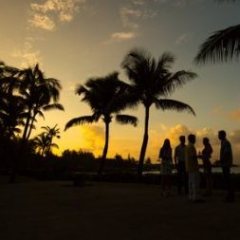
The sun was sinking fast, its lower edge already touching the water. Gold spilled across the waves, then deepened into amber, then into a red so rich it seemed almost molten. The clouds caught the light and changed with it—rose, violet, a fleeting green that vanished as soon as I noticed it.
Sam leaned his shoulder against a crate, arms folded loosely. “Good one tonight,” he said. “Sky’s puttin’ on a show.”
I stood beside him, close enough to feel the warmth of him through the cooling air. The wind brushed past us in long, gentle breaths, carrying the scent of salt and the faint sweetness of the galley’s evening fire.
The colors shifted again, the whole sky turning to a wash of crimson and gold that bled into the deepening blue above. The water mirrored it all, each swell catching the light like a polished blade.
Sam didn’t speak after that. He didn’t need to. His silence was steady, companionable—an easy quiet that felt as natural as the sea itself.
The last edge of the sun slipped beneath the horizon, leaving a long, glowing trail across the water. A single star appeared overhead, faint but certain.
Sam let out a slow breath. “Never gets old,” he murmured.
I nodded, though the words caught in my throat. The beauty of it—the vastness, the quiet, the warmth of Sam standing so near—settled deep in me, filling a place I had not known was hollow.
The light faded, the sky darkened, and still we stood there behind the crates, hidden from the world, watching the day give itself to night.
-
 5
5
-
 17
17
-
 1
1
Note: While authors are asked to place warnings on their stories for some moderated content, everyone has different thresholds, and it is your responsibility as a reader to avoid stories or stop reading if something bothers you.