
-
Newsletter
Sign UpKeep in touch with what's going on at Gay Authors and get emailed story recommendations weekly.
- Author
- 08/26/2025
- 4,847 Words
- 1,208 Views
- 25 Comments

Note: While authors are asked to place warnings on their stories for some moderated content, everyone has different thresholds, and it is your responsibility as a reader to avoid stories or stop reading if something bothers you.
When Your Exes Marry, Don't Kiss Your Fake Date - 1. When Your Exes Marry, Don't Kiss Your Fake Date
In three weeks, I’d be sitting at the wedding of my ex-boyfriend… to my fake boyfriend’s ex-boyfriend. And apparently, we were in love. Perfectly, photogenically, and convincingly in love. According to Jonas, anyway.
Jonas, the architect of this grand romantic deception, was currently nudging a framed photograph on my mantelpiece. For the third time. “It’s half a centimeter too low on the left,” he murmured, his brow creased with the kind of intense focus usually reserved for dismantling a bomb. The photo was one of us, a product of last week’s mandatory “candid” beach photoshoot. He’d insisted we needed a deep backlog of authentic-looking memories. In the picture, I looked happy, wind-tousled, and genuinely amused. Jonas, on the other hand, looked like he was mentally calculating the optimal angle of the sun’s reflection off the choppy waves.
“No one is going to be measuring our photo frames, you know,” I offered from my comfortable sprawl on the sofa. I was trying to project an aura of effortless calm, my natural state, which seemed to send a visible shiver down Jonas’s meticulously organized spine.
He finally stepped back, tilting his head. “Perfection is the accumulation of trifles, Dylan. And this wedding… this wedding will be perfect.”
I snorted into my lukewarm coffee. “It’s not our wedding, Jonas.”
He turned to face me then, and the look in his eyes was a vibrant, terrifying cocktail of panic and sheer determination. “It’s the public launch of our relationship. It’s a performance. And every single person there, especially Lysander and Marco, will see that we are not just fine. We are thriving.” He gestured around my apartment, a space I’d always considered a haven of comfortable chaos. Now, under his critical gaze, I saw it for what it was: a minefield of potential imperfections. My mismatched cushions, the pile of clean laundry on the armchair I’ve been using as a dresser, the coffee mug with a chip in its rim. All of it, a direct threat to the flawless romantic narrative Jonas was trying to script for us. And the most ridiculous part? I was starting to enjoy the show.
***
Our story, the real one, didn’t start on a sun-drenched beach. It started under the fluorescent hum of a hotel breakfast buffet in paradise a year ago. I was there with Marco; Jonas was there with Lysander. We were, ostensibly, on two separate romantic getaways. The kind of getaways that end with you single.
We met in the breakfast room. Two couples discovering there was only one table left near the window and deciding to share in that unspoken vacation way, where everyone is aggressively friendly because the ocean is pretty and the pastries are free.
I’d noticed Jonas and Lysander first. It was hard not to. They moved with a kind of synchronized precision, their plates piled with identical, sensible portions of fruit and gluten-free granola. Jonas had a crisp, linen shirt, and a look of quiet anxiety, while Lysander was all polished charm and expensive sunglasses. They were the picture of aspirational coupledom. Marco, who had the kind of smile that made strangers hand him their boats, and I were more of the ‘who can stack the most bacon on their plate’ kind of couple. On that day, I had mango on my shirt, a sunburn forming on my nose, and one flip-flop dangling from my fingers because the other had vanished sometime between the lobby and the omelet station.
“Do you need help?” Jonas asked, with the crisp politeness of a man who would help you but resent it forever.
“I need several kinds of help,” I said, and Marco laughed and kissed my cheek and told me I was chaos with legs. Which was fair.
That week had the glossy shine of a summer commercial. We snorkeled. We compared sunscreen brands. But I started noticing the small things. The way Marco’s laugh would echo Lysander’s a moment too late. The lingering conversations they’d have by the pool while Jonas was methodically applying sunscreen and I was engrossed in a trashy thriller. By day three, it was obvious. They weren’t just connecting; they were converging. The breakup conversation, when it finally happened, was almost a formality. Marco called it an “unexpected, undeniable soul connection.” I called it a cliché. He packed his bags, moved into Lysander’s ocean-view suite, and I ordered a bottle of champagne from room service. I’ve always believed that if a door closes, you should open a window and throw a party. Life’s too short for prolonged moping.
Jonas… did not share my philosophy. I saw him one last time, at the airport departure gate, looking utterly hollowed out. Lysander, ever the gentleman, had delivered the parting blow with surgical cruelty. I overheard it as I walked past. “Let’s be honest, Jonas,” he’d said, his voice dripping with faux pity, “Who could possibly put up with all… this?” He’d gestured vaguely at Jonas, as if his entire being was a tedious, insurmountable project. “You’ll be lucky if you ever find someone again.”
It was a spectacularly awful thing to say. And it had clearly embedded itself in Jonas’s psyche like a shard of glass.
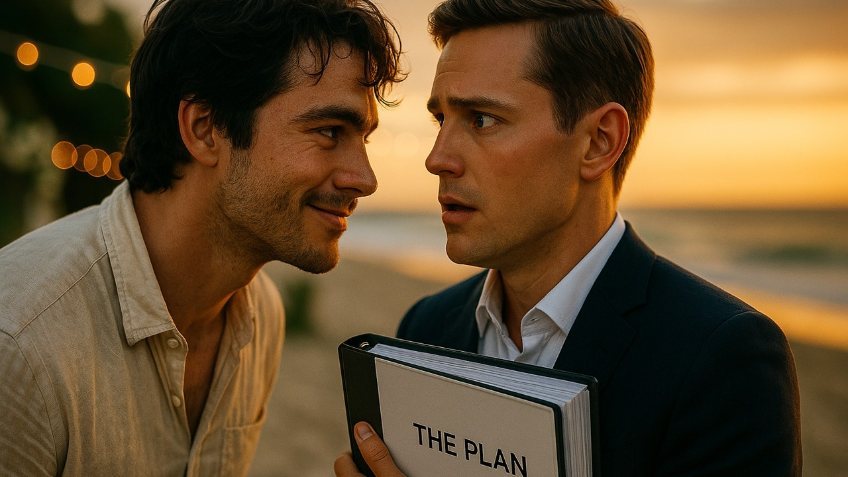
So, I wasn’t entirely surprised when he showed up on my doorstep ten months later, looking like a man on a mission. What did surprise me was the three-inch binder tucked under his arm.
“I have a proposal,” he announced, striding past me into my living room. He didn’t so much as ask; he just entered, his presence immediately making my casual clutter feel like a personal failing.
He set the binder down on my coffee table with a definitive thud. On the cover, in a crisp, sans-serif font, were the words: “Project Rebound.”
“Oh, good,” I said, leaning against the doorframe. “I was hoping for a project. I just finished organizing my sock drawer.”
He ignored my sarcasm, his fingers flipping open the binder to the first tab. “We find ourselves in a unique, if unfortunate, position. Our ex-partners are getting married. To each other. We will both be in attendance. It is, from a social standpoint, a nightmare.”
“I was planning on just getting drunk and requesting ‘I Will Survive’ at the reception,” I shrugged.
“No,” Jonas said, his voice firm. “We will not be objects of pity. We will be the picture of romantic success. Which is why we,” he tapped a perfectly manicured finger on the page, “are going to attend as a couple.”
It was all there. A complete, color-coded, cross-referenced history of a love that never was. Tab one: “The Story.” Our meet-cute was apparently a windswept afternoon on a beach, where I had gallantly rescued his runaway sunhat. Jonas had hated the beach on our real vacation; he’d complained about the sand getting in his loafers. Our first date, according to the binder, was a romantic boardwalk dinner under the stars, sharing a basket of fries. (The real Jonas would probably have a panic attack over the trans-fats). There were sections on our romantic quirks (I apparently found his meticulous planning endearing, and he was charmed by my ‘spontaneous spirit’), our shared interests (classic cinema, long walks, a mutual love for a niche artisanal cheese I’d never heard of), and a list of approved pet names. ‘J-Bear’ was, thankfully, crossed out.
His motivation was painfully clear. This wasn’t about Marco or me. This was a direct response to Lysander’s parting shot. This was Jonas’s way of screaming to the world, and mostly to his ex, “I am not unlovable. I am so lovable, in fact, that I found someone even better, and my life is a monument to perfection.” He wasn’t just fine; he was fabulous. And he had charts to prove it.
I should have said no. Any sane person would have shown him the door. It was controlling, obsessive, and frankly, completely unhinged. But as I watched him passionately explain the strategic importance of having pre-dated couple photos on our social media, I couldn’t help but smile. There was something about his desperate, controlling streak that was… funny. I’ve always been a sucker for chaos, and this was chaos in a beautifully organized, laminated package. He was a tightly wound coil of anxiety and ambition, and a part of me, a very stupid part, wanted to see what would happen if I just gave it a little poke.
And maybe, just maybe, as he looked up at me, his eyes wide with earnest, neurotic hope, I realized I found his controlling streak more than just funny. It was, heaven help me, kind of attractive.
“Fine,” I said, picking up the binder. “But I’m not calling you ‘My North Star’.”
A tiny muscle in Jonas’s jaw relaxed. “Excellent. Rehearsals start tomorrow.”
***
Rehearsing a fake relationship with Jonas was like being in the world’s most intense, low-stakes improv class. Every Tuesday and Thursday for a month, we’d meet to run our lines, to drill the manufactured story of “us” into our brains until it was second nature. And every Tuesday and Thursday, I made it my personal mission to drive him absolutely insane.
“Okay, from the top,” he’d say, pacing my living room, binder in hand. “The boardwalk. First date. I had just commented on the beautiful sunset.”
“Right,” I’d chime in, leaning back on the sofa. “And I said it was almost as beautiful as the way you heroically fought that seagull for the last of our onion rings. A true warrior.”
Jonas would stop pacing and pinch the bridge of his nose. “There were no seagulls, Dylan. We shared the calamari. It’s in the ‘Approved Anecdotes’ section, sub-section ‘Food-Related Banter’.”
“I feel like the seagull story has more texture,” I’d argue. “It shows my admiration for your strength. It’s a moment of vulnerability.”
“It’s a moment of absurdity!”
The centerpiece of his plan was photographic evidence. Jonas had scheduled a series of photoshoots to populate our social media with a believable timeline of our love. Our first outing was to a local park for a “spontaneous” picnic. Jonas had brought a wicker basket with a red-and-white checkered blanket, a baguette that was precisely 30 centimeters long, and a wedge of the aforementioned artisanal cheese. I brought a bag of salt and vinegar chips and made a hat out of my napkin. He’d set up his phone on a tripod, the self-timer clicking away as he tried to direct me into poses that screamed ‘effortless romance.’
“Okay, now laugh,” he’d command from under my arm, his smile a rigid, terrifying grimace. “Laugh like I just said something utterly charming.”
“You just told me my elbow was at a suboptimal angle for creating a pleasing silhouette,” I deadpanned. He sighed, a long, suffering sound, and I couldn't help it. I burst out laughing for real. The camera clicked, capturing the one genuine moment of the entire afternoon: me with my head thrown back in a real laugh, and Jonas looking at me with an expression of pure, unadulterated exasperation. It ended up being his favorite picture. “It shows dynamic contrast,” he’d reasoned, though I saw the hint of a smile he tried to hide.
It was during our fifth rehearsal, a week later, that the project hit a snag. We were running through "Charming Conversation Topics," and I was getting progressively more bored and, consequently, more ridiculous.
“And that’s when I knew,” I declared, gesturing grandly, “that my life’s purpose was to create a sanctuary for retired circus squirrels.”
Jonas’s pen stopped scratching against his notepad. He looked up slowly. “That’s not in the binder, Dylan.”
“It’s called character depth, Jonas. The binder doesn’t say I don’t have a passion for squirrel rehabilitation.” I leaned back dramatically against the wall for emphasis, right next to the leaning tower of books I’d been meaning to fix for six months. There was an ominous creak, a groan of tortured particleboard, and then a thunderous crash.
The bookshelf, my beloved monument to procrastination, had finally given up. Books, photos, and assorted junk cascaded onto the floor. Dust motes danced in the afternoon light.
I stared at the mess, then back at Jonas, and shrugged. “Well, that’s a problem for future Dylan.” I started scooping books into a pile with no discernible system.
“Stop.” Jonas’s voice had a new tone. It wasn’t panicked or annoyed. It was... activated. He walked over to the wreckage, his eyes scanning the broken shelf supports and scattered screws. The architect in him had taken over. “This isn’t a storage issue, it’s a structural failure. We need to fix it.”
“‘We’?” I asked, holding up a dusty copy of a cookbook I’d never opened. “‘We’ have a rehearsal to finish.”
“The rehearsal is paused,” he announced, already taking measurements with his eyes. “My car has a toolbox. Don’t touch anything. I need to assess the damage.”
For the next two hours, the fake relationship was forgotten. It was just me and Jonas and a pile of broken wood. I expected him to be tyrannical, to direct me with the same rigid energy he applied to our fake origin story. But he wasn’t. He was focused, efficient, and surprisingly calm. He saw a problem and simply, methodically, began to solve it. My chaos didn't seem to annoy him; it was just a set of variables to be managed.
He taught me how to find a stud in the wall, the difference between a Phillips and a flathead screwdriver, and why you should always measure twice. As we worked, we talked. Really talked, without a script. I asked him where he learned all this.
“My dad,” he said, his voice a little softer as he tightened a bracket. “He was an engineer. He believed the world was just a series of problems that could be solved with the right tools and enough patience.” He paused, looking at the half-repaired shelf. “Lysander hated it. He called it my ‘tinkering.’ Said it was… common.”
I stopped what I was doing and looked at him—really looked at him. I saw the flash of old hurt in his eyes. “It’s not common,” I said, my voice quieter than I intended. “It’s amazing. You’re literally bringing order to my chaos right now.”
His hands stilled. He looked up and met my gaze, and the air in the room shifted. We were standing close, the smell of sawdust and old paper around us. For a long, charged moment, there was no binder, no exes, no wedding. There was just the two of us, in a dusty corner of my apartment, having built something real together.
He cleared his throat and looked away, breaking the spell. “The top shelf should be reserved for paperbacks only. Lower center of gravity.”
But the spell didn’t really break. Something had been fixed, and it wasn’t just the bookshelf.
That evening, after the tools were packed away and the books were neatly (and structurally-soundly) stacked, I put the binder aside and ordered a pizza—a greasy, foldable, New York-style pizza that was nowhere on Jonas’s approved food list.
He stared at it when it arrived, but he didn’t protest. He sat with me on the floor, and as I recounted a ridiculous story from my college days involving a stolen campus mascot, I saw his shoulders relax. Then, a small, unfamiliar sound escaped his lips. A chuckle. It was a rusty, hesitant sound, like an engine that hadn’t been started in years, but it was there. Soon, it grew into a full, genuine laugh that made his eyes crinkle at the corners.
“What?” I asked, a slice of pepperoni halfway to my mouth.
He shook his head, a real smile finally breaking through his carefully constructed facade. “It’s just… with Lysander, everything was a performance. Everything had to be perfect, curated, and optimized. If I laughed too loudly, it was unrefined. If I told a stupid joke, it was embarrassing.” He looked at me, a flicker of something soft and vulnerable in his gaze. “Your… chaos,” he said, gesturing to my messy apartment and the greasy pizza box, “it makes me feel less stuck in my own head.”
I felt a warmth spread through my chest that had nothing to do with the pizza. “Well, stick with me, J-Bear,” I said, nudging his foot with mine. “I’ve got a lifetime supply of chaos.”
He winced at the nickname but didn’t pull his foot away. And in that quiet moment, surrounded by pizza crusts and the laminated lies of our fake love story, it felt a little less fake than it had the day before.
The wedding was being held at a boutique coastal resort, the kind of place with more artfully placed driftwood than actual furniture. We arrived on Friday afternoon, stepping out of the car and into our roles. Jonas was the picture of effortless elegance in a tailored navy blazer, his hair perfectly coiffed, a serene smile plastered on his face. He was in character. I, on the other hand, was winging it in a slightly wrinkled linen shirt, my sunglasses askew. I was his charmingly chaotic other half.
“Ready?” he murmured, his hand finding mine. His palm was clammy.
“Born ready,” I whispered back, giving his hand a reassuring squeeze. “Just remember: no seagulls.”
The performance began the moment we checked in. Jonas handled the concierge with a cool, practiced charm, while I pointed out a painting of a boat that I was sure was hanging upside-down. The combined effect was, apparently, fascinating. We were an odd, compelling pair. Guests—friends of Marco and Lysander who had only known us as halves of a different equation—watched us with open curiosity. Whispers followed us to the welcome cocktail hour. “Is that… Dylan? With Lysander’s ex?” “They look so… happy.”
Jonas, who craved control, was flustered by the unscripted attention. He’d planned for pity and morbid curiosity, not genuine fascination. Every time a guest would approach to gush over how wonderful it was that we’d found each other, his perfect smile would tighten at the edges. I, however, was having the time of my life, improvising elaborate additions to our backstory. By the end of the night, I had half the guests convinced that Jonas was a former international spy and our first date involved a high-speed chase through Monaco. Jonas just stood beside me, sipping his sparkling water and looking faintly ill.
And then there were the exes. They hovered on the periphery like beautifully dressed ghosts. Marco, my ex, was awkwardly friendly, all big, clueless smiles. He clapped me on the shoulder, told me it was great to see me looking so well, and seemed genuinely oblivious to the seismic levels of awkwardness he was generating. He was a golden retriever of a man; you just couldn’t stay mad at him.
Lysander was another species entirely. He circled us like a shark, his smile sharp and predatory. He approached us by the raw bar, his gaze flicking between me and Jonas with condescending amusement. “Jonas. Dylan. Well, isn’t this… cozy,” he purred. “I must say, Jonas, I’m surprised. I never pictured you with someone so… relaxed.” The subtext was clear: messy, unkempt, a downgrade.
Before Jonas could retreat into his shell, I slung an arm around his shoulders, pulling him close. “He’s a sucker for my spontaneity,” I said with a wide, easy grin. “It keeps him on his toes. Just last week, I convinced him we should adopt a goat. We named it Lysander.”
Lysander’s smile faltered. He hadn't expected me to bite back. He gave a clipped nod and slithered away, leaving Jonas staring at me with a look of stunned admiration.
The ceremony itself was held on the beach. A beautiful, picturesque, and profoundly stony beach. The wedding invitation had mentioned ‘seaside elegance’ but failed to specify the terrain. As the procession began, a wave of comedic chaos rippled through the guests. Women in stilettos sank into the gravel, men in slick dress shoes stumbled and slid. Everyone was forced into a bizarre, tiptoeing gait, their arms flailing for balance. They looked like a flock of startled flamingos.
Jonas and I, having scouted the location that morning (at his insistence), had both worn loafers. We stood at the back, perfectly stable, sharing a secret, triumphant smirk. "Looks like they didn't read the operational brief," Jonas murmured in my ear, his voice laced with a humor so dry it was practically a fire hazard. I had to stifle a laugh with my hand. In that shared moment of amusement, watching our exes' perfectly curated wedding descend into a slapstick comedy, we felt more like a real couple than ever before.
The reception was where it all came to a head. The marquee was aglow with fairy lights, the champagne flowed freely, and Lysander and Marco took to the floor for their first dance. It was all very tasteful and romantic. And according to Jonas’s binder, it was our cue.
“Phase four: The Public Display of Affection,” he whispered, his voice tight with nerves. “It has to be convincing, but not ostentatious. A six-second kiss, medium passion, slight head tilt to the left for the optimal sightline from their table.”
“Got it, coach,” I said, taking his hand and leading him to the edge of the dance floor.
As the song swelled, we turned to each other. He looked at me, his eyes searching mine, and for a second, the meticulous planner was gone. In his place was just Jonas, vulnerable and uncertain. I forgot about the sightlines and the six-second rule. I forgot about the binder and the performance. I gently cupped his face with my hands, my thumb stroking his cheek, and I leaned in and kissed him.
And the world fell away. It wasn’t a performance. It was a confession. It was the culmination of every shared laugh, every late-night pizza, every moment of accidental intimacy. His lips were softer than I’d imagined, and he kissed me back with a hesitant, desperate-for-air urgency that made my heart ache. It was six seconds, then ten, then I lost count. We were the only two people in the tent.
When we finally broke apart, we just stared at each other, breathless. The carefully constructed wall between what was fake and what was real had been utterly demolished.
“Well, well, well.”
Lysander’s voice cut through our daze. He was standing right there, a glass of champagne in his hand, his eyes glittering with a familiar, nasty triumph. “What a touching performance. You almost had me convinced.”
Jonas flinched, his face paling. The old wounds, I could see, were still raw. He opened his mouth to say something, but I stepped slightly in front of him, a protective instinct I didn't know I possessed surging through me.
“It’s not a performance,” I said, my voice quiet but firm. “But I’m glad you’re enjoying the show. You’ve got a front-row seat to see what actual happiness looks like. You should take notes.”
Lysander was taken aback. He was used to Jonas cowering, not being defended. He looked from my defiant face to Jonas’s stunned one.
“He’s happy,” I continued, not breaking eye contact. “He laughs at stupid jokes, he’s kind, and he’s brilliant. And that thing you said to him? About him being lucky to find someone? It was the other way around, pal. Anyone would be lucky to have him.”
A wave of emotions washed over Lysander’s face: shock, embarrassment, and then, a flicker of something that looked like genuine regret. He looked at Jonas, really looked at him, and the sneer was gone.
“He’s right,” Lysander said, his voice barely a whisper. “What I said… it was cruel. I was hurt, and I wanted to hurt you. I’m sorry, Jonas.”
And the most amazing thing happened. Jonas looked at his ex, the man whose approval he had so desperately, pathologically craved, and he gave a small, calm smile. He took my hand, his grip firm and steady.
“Thank you, Lysander,” Jonas said, his voice clear and strong. “But I don’t need to hear that anymore.”
He didn’t need the apology. He didn’t need the validation. He had turned to look at me, and in his eyes, I saw that he already knew his own worth. The project was a success. Not because he had fooled his ex, but because he had finally convinced himself.
The drive home was a study in comfortable silence. The unspoken truth of that kiss hung in the air between us, thick and sweet like the summer humidity, but it wasn't awkward. It was a promise.
Back at my apartment, the first thing we saw was the infamous binder sitting on the coffee table—a monument to a mission that had become obsolete. In a move of quiet finality, Jonas walked over to it, picked it up, and without a word, dropped the entire three-inch bible of our fabricated lives into the recycling bin. The sound it made was a satisfying thud. The end of an era.
“I guess the project is over,” I said, my voice sounding unnaturally loud in the quiet room.
“The primary objective was met,” Jonas replied, his tone still carrying a trace of his formal, mission-oriented self. He turned to face me, but the look in his eyes was anything but clinical. He wasn't looking at his co-conspirator; he was looking at me, Dylan. The man he had kissed like his life depended on it.
The air crackled. The carefully drawn lines of our arrangement had been completely erased, and the future was a terrifying, thrilling blank page. “So, what now?” I asked, my heart thumping a chaotic rhythm against my ribs. “Is there a contingency plan for… this?”
Jonas gave a small, uncertain shake of his head. “The binder’s operational scope concluded at the end of the wedding weekend. There are no more phases.” He looked almost lost for a second, a master planner without a blueprint. His entire world for the past few months had been geared toward this one goal, and now that it was over, he was adrift.
And in that moment, I knew it was my turn.
While he was staring at the space where the binder used to be, I grabbed a pen off the counter and snatched a crumpled cocktail napkin from my pocket—a souvenir from the wedding reception. I smoothed it out on the coffee table and, in my messy, sprawling handwriting, I began to write.
When I was done, I slid it across the table to him.
He looked down. On the flimsy, slightly damp square of paper were a few simple lines.
Project: The Real Thing
- Phase 1: Figure out what “us” is. No script.
- Phase 2: Get it right this time.
- Timeline: Starts now.
Jonas picked up the napkin as if it were a fragile artifact. He read it once, then twice. A long silence stretched between us, and I held my breath. He ran a thumb over my messy handwriting, a stark contrast to the crisp, sans-serif font of his own defunct plan. I had given him a future with no metrics, no approved anecdotes, and no color-coded tabs.
Finally, he looked up at me, and a slow, brilliant smile spread across his face. It was the smile I’d seen when he’d fixed my bookshelf, the real one that reached his eyes and made them shine.
“This is a terrible plan,” he said, his voice soft with an emotion I couldn't quite name. “The objectives are vague. There are no action items, no risk assessments, no defined metrics for success.”
He stood up and walked around the table until he was standing in front of me. He held up the napkin, our new, ridiculous charter.
“It’s the most illogical, unprepared, and chaotic proposal I have ever seen,” he murmured, his eyes searching mine. He gently tucked the napkin into his shirt pocket, right over his heart. “It’s perfect. When do we start?”
I let out the breath I didn’t know I was holding in a laugh. “The timeline,” I said, my voice thick with relief and something much, much deeper, “starts now.”
He took my hand, his grip firm and steady, his palm no longer clammy but warm and sure. He pulled me toward the door, not with the frantic, nervous energy of the man who had shown up with a binder weeks ago, but with the quiet confidence of a man who finally knew where he was going, even without a map.
As I pulled the door closed behind us, I looked at him, the city lights just beginning to sparkle in the twilight. “So,” I asked, a grin spreading across my face. “Where to, boss?”
Jonas looked down at our joined hands, then back at me, his smile a beacon in the dusk.
“I have absolutely no idea,” he said. “And for the first time in my life, that feels like the perfect plan.”
Thank you so much for reading!  I hope you enjoyed Dylan and Jonas's story.
I would absolutely love to hear your thoughts and feedback in the comments!
Just a warning: I'm just getting started with my rom-com phase -- expect more! 😅
And, as always, if you'd like to experience the story in another way, I've created a video with a full audio narration, accompanied by some cozy, animated illustrations and music. You can watch it here: https://youtu.be/Y7PxPehp5k0
-
 1
1
-
 21
21
-
 1
1
Note: While authors are asked to place warnings on their stories for some moderated content, everyone has different thresholds, and it is your responsibility as a reader to avoid stories or stop reading if something bothers you.